When people think about theater scenery, they usually focus on creating interesting, beautiful, and functional set pieces that help tell the story of the production. What they don’t usually think about is where all that scenery will go after the show closes.
In my experience, storage is one of the biggest challenges facing school and youth theater programs. It is also one of the least discussed. Many of the scenic decisions that seem perfectly reasonable during production can become problematic once the final performance is over and everything needs a place to live.
The Hidden Cost of Every Set Piece
Every time you build a set piece, you are making a commitment that extends far beyond opening night.
That piece will need to be stored, maintained, repaired, repurposed, transported (potentially), and eventually discarded when it reaches the end of its useful life.
The initial cost of lumber, paint, and hardware is only part of the investment. The ongoing cost is measured in storage space (especially if you are paying for storage), volunteer labor, and organizational effort.
Schools rarely have unlimited amounts of any of those resources.
The “We Might Use It Someday” Problem
Most theater programs operate on tight budgets. Lumber is expensive. Building scenery takes time. Volunteers work hard to create these pieces.
As a result, throwing something away can feel wasteful.
After all, what if it can be used again someday?
This mindset is completely understandable. In fact, I often feel the same way.
The problem is that after several years, many theater storage spaces become filled with:
- Oversized specialty set pieces
- Random furniture
- Broken set pieces waiting for repair
- Boxes of unidentified props
- Lumber scraps that seemed useful at the time
Individually, each item may have some potential value. Collectively, they create clutter that makes it difficult to access, organize, and maintain the pieces that are actually useful.
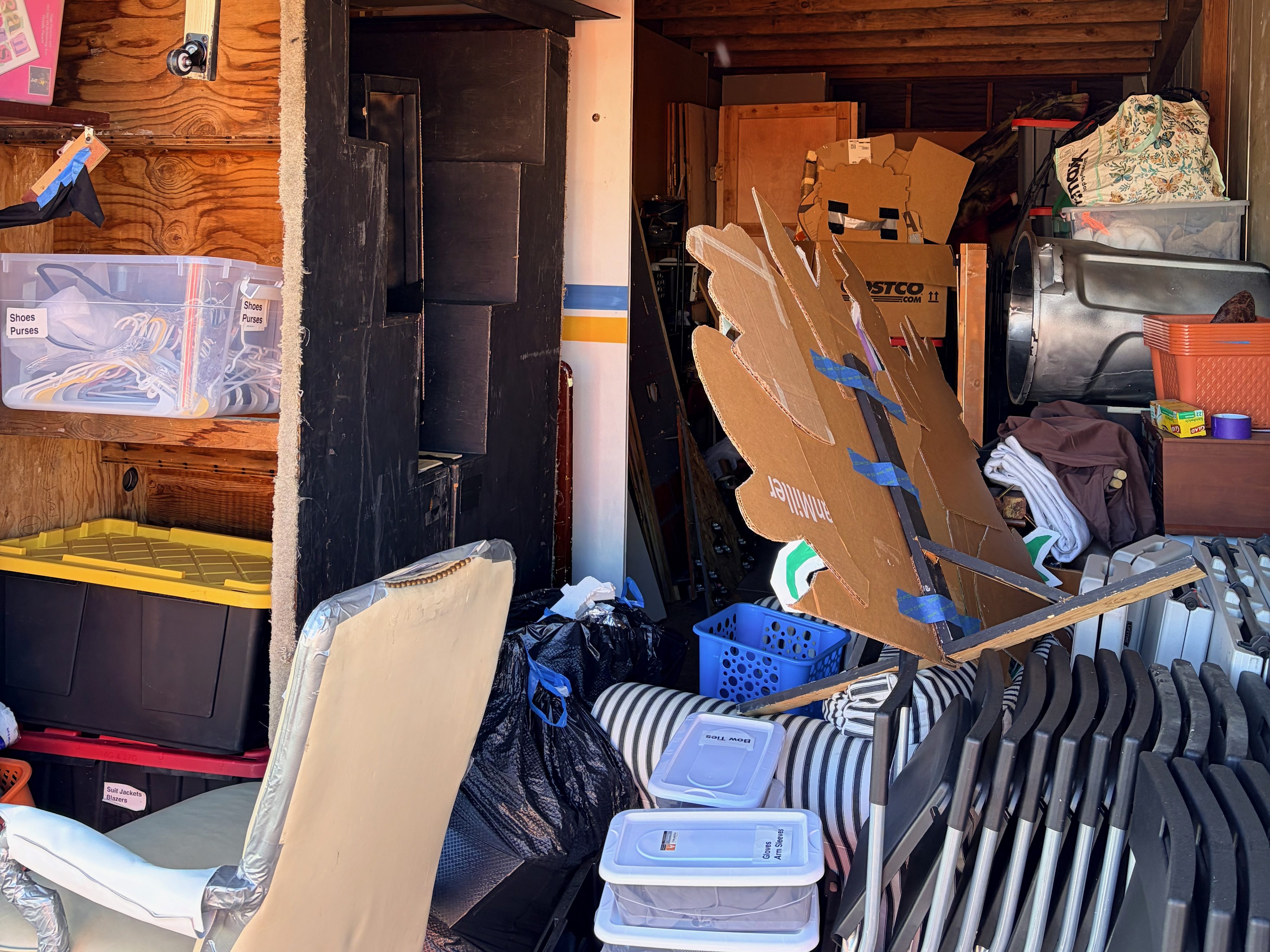
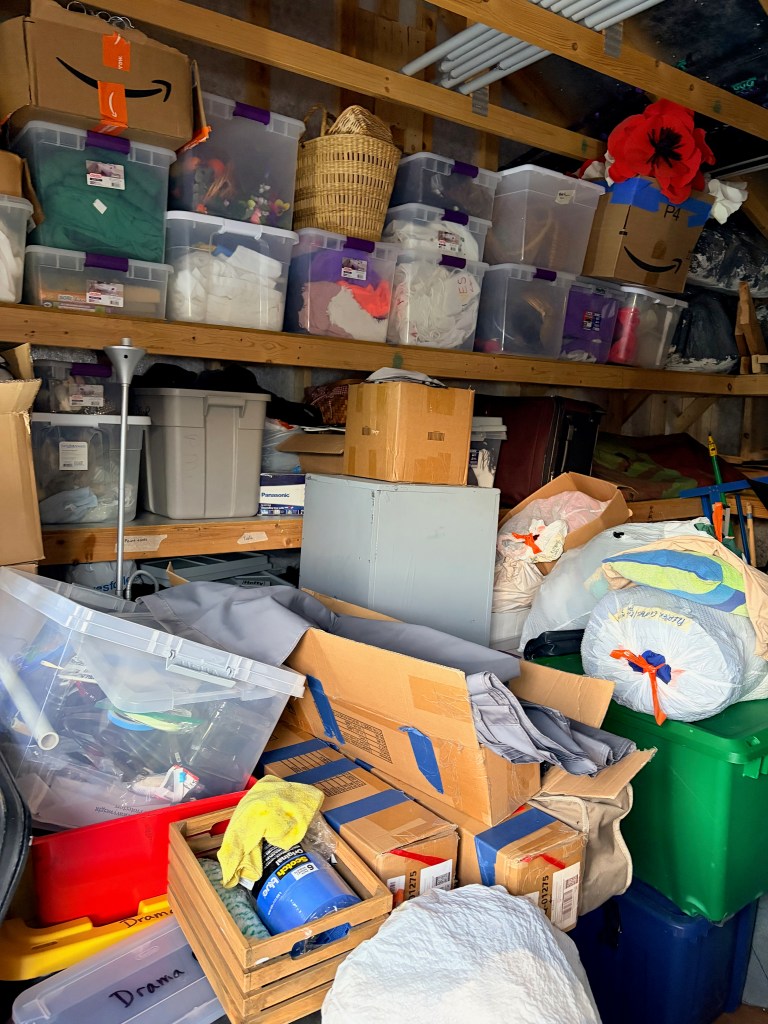
Before long, the storage area becomes a disaster zone. It becomes difficult to know what you have. Duplicate items are purchased. Valuable volunteer time gets spent cleaning and reorganizing instead of working on the current production.
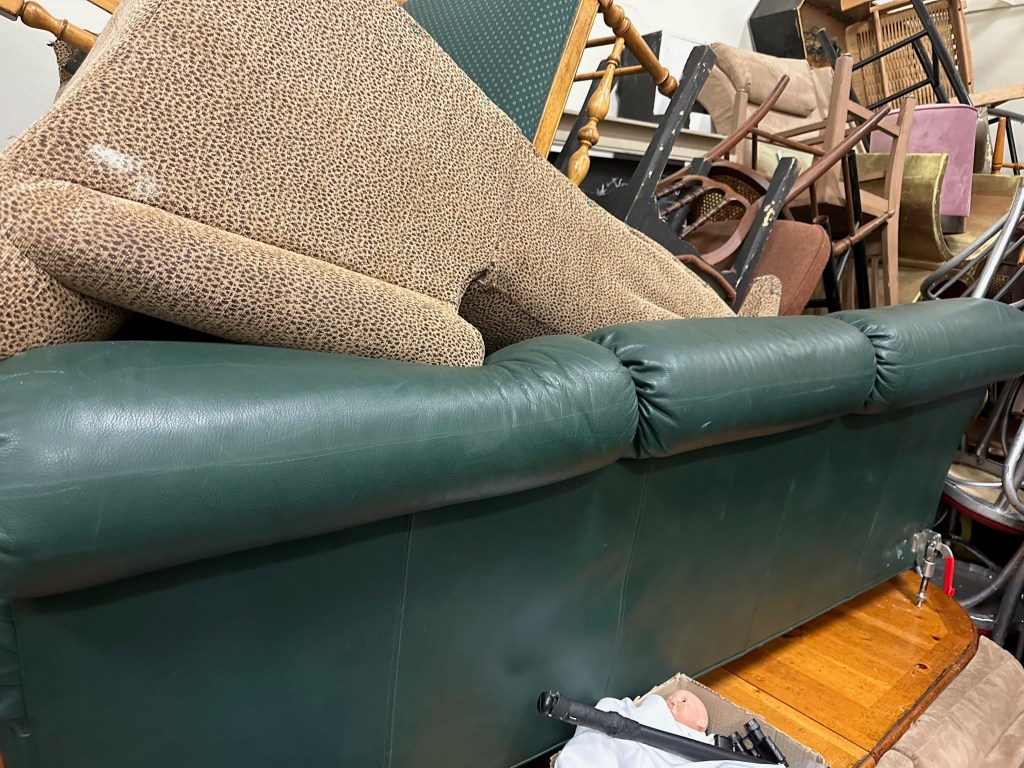
I have seen storage units so full that it was impossible to enter without removing many large items. One storage space I encountered was filled with dangerously stacked furniture such as couches and posed a serious safety hazard to anyone trying to pull items from the space. I have also seen storage situations where cardboard boxes of props and set pieces were stacked in such a way that many of the items were getting damaged or broken.
Storage Should Influence Design
One of the biggest shifts in my thinking has been realizing that storage needs should influence scenic design from the very beginning.
Before building a large scenic element, I now try to ask questions such as:
- Where will this be stored after the show?
- Can it be reused for future productions?
- Can students move it safely?
- Will it fit through doorways?
- Does it stack efficiently?
- Can it be disassembled for storage?
- Is there a simpler way to achieve the same storytelling goal?
These questions may not be as exciting as discussing what will look best on stage, but they often have a much larger impact on the long-term success of a theater program.
My Rules for Theater Storage
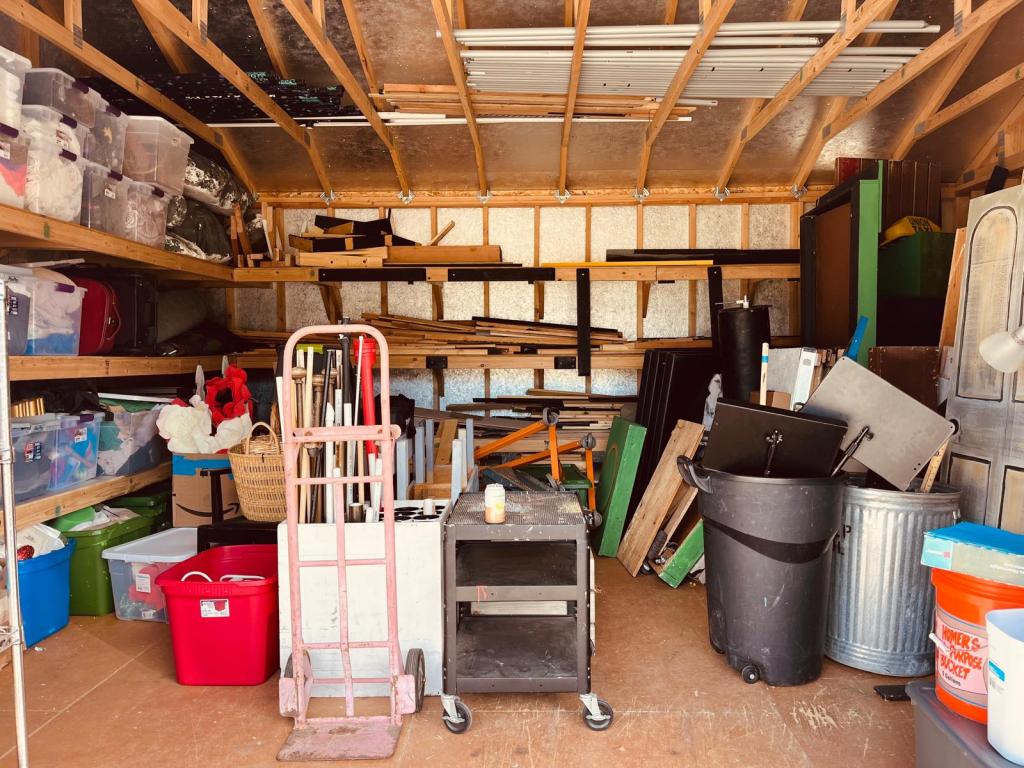
Over the years, I’ve developed a few guidelines that help keep storage areas from becoming overwhelmed.
Rule #1: Don’t Build Anything Without a Storage Plan
Before construction begins, ask:
“Where will this live after the show?”
If the answer is, “We’ll figure that out later,” reconsider the design.
I’ve seen many beautiful set pieces discarded simply because nobody planned for where they would be stored.
Rule #2: Prioritize Modular Pieces Over Show-Specific Pieces
When possible, invest in scenery that can be reused in multiple productions.
Examples include:
- Platforms
- Stair units
- Flats
- Periaktoi
- Benches
- Tables
- Rolling wagons
A generic platform can be used in dozens of shows.
A giant dragon cave entrance can probably only be used in one.
Rule #3: Storage Footprint Matters
One question I constantly ask is:
“Does the value this piece adds to productions justify the space it consumes year-round?”
A useful scenic piece should earn its place in storage.
Large specialty pieces that are rarely used often take up valuable space that could be devoted to more versatile items.
Rule #4: Design for Student Handling
If adults struggle to move a set piece, students probably will too.
Whenever possible, scenery should:
- Fit through doors
- Fit in storage areas
- Be movable by a small group of students
- Be stable and safe
The easier scenery is to move, the easier it is to store and the more likely it is to be reused.
Rule #5: It Is Okay to Let Things Go
This is often the hardest rule.
Schools spend significant time and money building scenery, so there is a strong desire to keep everything.
But sometimes the most valuable thing you can do for a storage area is remove pieces that no longer serve a purpose.
Every item kept in storage has an ongoing cost.
Bigger Is Not Always Better
Many people assume that larger, more realistic scenery automatically creates a better production.
Sometimes that is true.
More often, however, large specialty pieces create challenges that continue long after the audience has gone home.
A giant castle wall may look impressive for one production. But if it occupies valuable storage space for the next five years and is never used again, was it really the best investment?
In school theater, practical considerations matter.
The best scenic solution is not always the most impressive one. Sometimes it is the one that can be reused, reconfigured, and stored efficiently.
Designing for Reuse
Over the years, I have increasingly turned to modular scenery systems.
Rather than building entirely new scenery for every production, I prefer investing in versatile pieces that can be adapted to many different shows.
Examples include:
- Platforms
- Stair units
- Double-sided flats
- Periaktoi
- Rolling wagons
- Pipe and drape systems
- Interchangeable magnetic wall décor
These types of pieces can be combined in countless ways while requiring far less storage space than a collection of highly specialized scenic units.
A school that owns a well-designed collection of modular scenery can often create a surprising variety of stage environments without constantly building from scratch.
The Goal Is Sustainability
When I design scenery for school musicals, I am not just thinking about opening night.
I am also thinking about:
- Next year’s production
- The volunteers who will move the scenery
- The students who will set it up
- The available storage space
- The room available backstage and in the wings
A successful theater program is not built on a single impressive set. It is built on a collection of flexible, reusable tools that can support production after production.
Final Thoughts
Storage may not be the most exciting aspect of scenic design, but it is one of the most important.
Every theater program eventually reaches a point where storage space becomes a constraint. When that happens, the programs that thrive are usually the ones that have invested in flexible, reusable, and practical scenic systems.
The goal is not to build the biggest set possible.
The goal is to create the most useful collection of scenery that your theater program can realistically maintain, store, and reuse for years to come.
In my experience, that approach leads to less stress, more flexibility, and ultimately better productions.


Leave a Reply