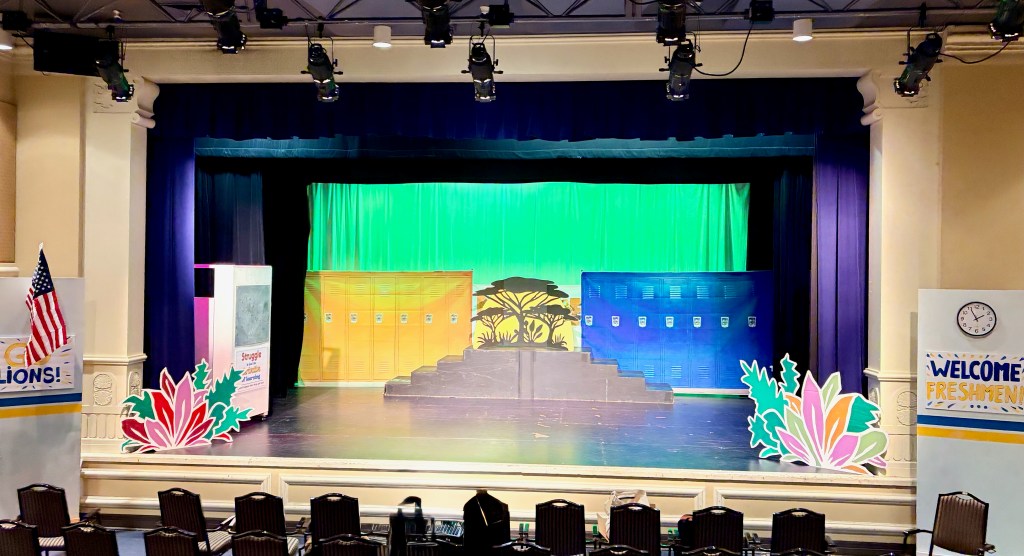
When many people imagine theater scenery, they picture elaborate Broadway sets with giant moving walls, realistic furniture and props, and complicated special effects. While those productions can certainly be impressive, school and youth theater operate under very different conditions — and that’s okay.
In fact, simple scenery is often the better choice for school musicals.
Over the years, I’ve learned that the most successful youth theater productions are not necessarily the ones with the largest budgets or the most complicated scenery. They are the productions that thoughtfully balance storytelling, practicality, student involvement, volunteer workload, and stage functionality.
The Performers Should Be the Focus
In youth theater, the students are the heart of the production. The scenery should support the story and help establish the atmosphere of the show, but it should not distract from the performers themselves.
The audiences for school musicals are often made up primarily of family members and friends who already have some familiarity with the story, characters, or setting of the show. Because of this, productions do not always need elaborate realism to help audiences understand where scenes take place.
A few carefully chosen scenic elements can often establish a location more effectively than an overly detailed set. A table and two chairs can suggest a dining room. A bench can suggest a park. Classroom posters and a few desks can quickly establish a school setting.
In youth theater, it is especially important that scenic design supports young performers rather than overpowering them. The audience’s attention should remain on the students and their performances.
The audience does not need a fully realistic environment to understand where a scene takes place. Theater works because the audience is willing to imagine alongside the performers.
Simple Scenery Improves Transitions
One of the biggest challenges in school theater is scene transitions. Large or complicated scenery often means:
- longer blackouts,
- more backstage confusion,
- increased volunteer workload,
- and more opportunities for mistakes.
In musicals especially, pacing matters. Long pauses between scenes can interrupt the momentum of the production and pull the audience out of the story.
Simple, modular scenery allows transitions to happen more quickly and smoothly. Lightweight pieces can be moved by students, actors, or volunteers with minimal disruption to the performance.
Sometimes changing just a few scenic elements is enough to completely transform a scene.
Storage Matters More Than Most People Realize
Many school theater programs have very limited storage space. Some productions rehearse and perform in cafeterias, gyms, multipurpose rooms, or shared theater spaces. Large custom-built scenery can quickly become difficult to store, transport, and reuse.
This is one reason I strongly believe in modular stock scenery systems.
Reusable scenic pieces such as:
- platforms,
- cubes,
- rolling flats,
- benches,
- periaktoi,
- and pipe-and-drape systems
can be reconfigured for many different productions while taking up far less storage space than large show-specific builds.
Over time, these reusable pieces become one of the most valuable investments a theater program can make.
Volunteers Need Achievable Systems
Many school productions rely heavily on parent volunteers, and most volunteers are not professional scenic designers or carpenters. I know this firsthand because I started as a parent volunteer with very little theater or construction experience.
Complicated scenery often creates unnecessary stress for volunteers who are already balancing jobs, families, and other responsibilities.
Simple scenic systems are easier to:
- build,
- paint,
- organize,
- transport,
- repair,
- and reuse.
They also allow volunteers to divide up work more effectively without needing advanced technical skills.
A production does not need to look like Broadway to feel magical for students and audiences.
Student Involvement
Simpler scenic systems can also create more opportunities for student involvement.
When volunteers are willing to mentor and guide students, involving students in scenic design and construction can be incredibly rewarding for everyone involved. Students often bring creative and unexpected ideas to the design process, and giving them ownership over parts of the production can increase both excitement and confidence.
Encourage students to sketch ideas, help paint scenery, organize props, and participate in age-appropriate construction tasks whenever possible. Providing structure and reasonable constraints helps students contribute successfully while still allowing room for creativity.
Whenever possible, I highly encourage involving students in all aspects of producing a show — not just performing on stage.
Simple Does Not Mean Boring
Simple scenery does not mean a boring, empty stage.
Thoughtful lighting, props, costumes, set dressing, choreography, and staging can do an enormous amount of storytelling work. In many cases, simpler scenery actually gives productions more flexibility and keeps the audience focused on the action happening on stage.
Some of the most visually successful youth productions I’ve worked on relied on:
- modular scenic pieces,
- rotating periaktoi,
- simple backdrops,
- lightweight rolling units,
- and flexible set dressing
rather than massive realistic builds.
When designed intentionally, simplicity can feel cohesive, creative, and highly theatrical.
Focus on What Matters Most
At the end of the day, school theater is about students, storytelling, creativity, teamwork, and shared experiences.
The goal is not perfection.
The goal is creating a production environment where students can shine and volunteers can realistically support the process without becoming overwhelmed.
Simple scenery helps make that possible.


Leave a Reply